
Key Takeaways
- Home insurance premiums in Canada rose over 4% year-over-year into 2026, outpacing general inflation and showing no signs of reversing soon.
- Climate-related losses, rising construction costs, and aging housing stock are the three primary forces pushing Ontario premiums upward.
- A single insurance claim in Ontario can raise your annual premium by as much as 20%, making prevention a smarter financial strategy than filing for smaller losses.
- Rural Ontario homeowners consistently pay higher premiums than their urban counterparts, with some northern communities paying over $2,000 per year for standard coverage.
- Practical steps — from installing a backwater valve to bundling your policies — can meaningfully reduce what you pay without sacrificing meaningful coverage.
- Shopping your policy annually and working with an independent broker are the two most underused tools available to Ontario homeowners right now.
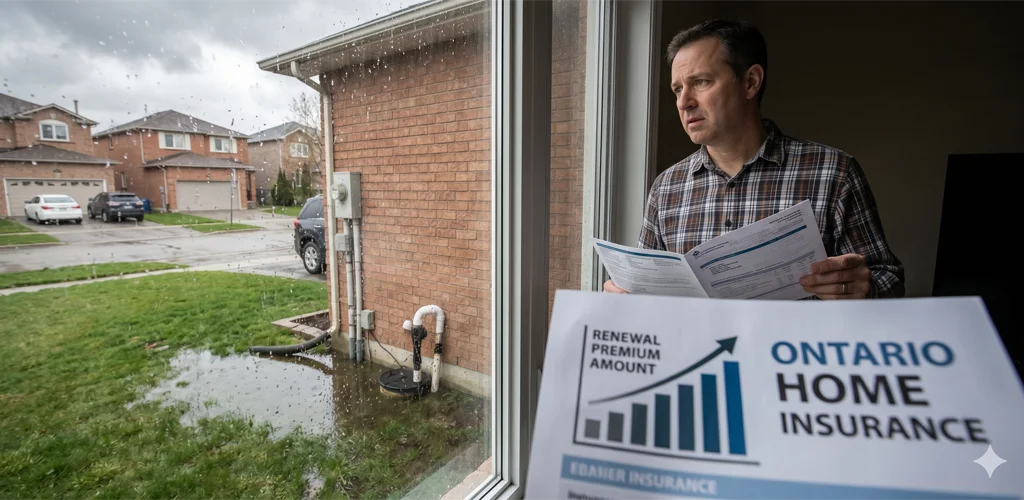
There is a bill that arrives every year, gets opened with a quiet sigh, and gets paid without much thought — until suddenly it is noticeably higher than it was twelve months ago. For most Ontario homeowners in 2026, that bill is home insurance. And the frustrating part is not just that premiums are rising. It is that they feel completely disconnected from anything you have personally done or not done. Your home has not changed. Your neighbourhood has not flooded. You have not filed a single claim. And yet the number on the renewal is higher anyway.
That frustration is entirely valid. But understanding why it is happening — and what actually moves the needle in your favour — turns out to be genuinely useful, both for your budget and for the decisions you make about your home over the next few years.
The Numbers Behind the Frustration
Home insurance premiums across Canada increased by just over 4% year-over-year heading into 2026. That might sound modest, but it sits well above the country’s general inflation rate of around 2.3%, meaning insurance costs are outpacing the broader economy. For Ontario homeowners specifically, that trend has been building steadily for several years — and the forces driving it are not short-term noise. They are structural shifts that the insurance industry is pricing in with every renewal cycle.
The average Ontario homeowner in a standard suburban area pays somewhere between $1,200 and $1,500 per year for home insurance. But that number swings dramatically based on location, home age, and risk profile. Rural homeowners in northern Ontario are regularly paying more than $2,000 annually — and in some communities have seen increases in the double digits year over year.
If your premium has jumped in a way that feels disproportionate to your circumstances, you are probably not wrong. What has changed is not necessarily your home — it is the broader risk environment that every home in your region is now being priced against.
Three Forces That Are Actually Driving Your Premium Up
Weather Events Are Getting More Expensive
The single biggest driver of rising home insurance costs in Ontario — and across Canada — is the increasing frequency and severity of weather-related losses. The numbers are striking. Total severe weather-related insured losses in Canada exceeded $2.4 billion for the 2025 calendar year alone. To put that in context, the average annual catastrophic loss between 1983 and 2008 was around $400 million. Today that figure is approaching $2 billion as a new normal — and 2024 set a record at $9.4 billion.
Insurance companies do not absorb those losses in isolation. They rely on a global system of reinsurance to manage large-scale risk, and as catastrophic events around the world have grown more expensive, reinsurance costs have climbed with them. Those costs eventually find their way to your renewal premium — even if your street stayed perfectly dry all year.
Water damage has become especially influential in Ontario specifically. The province deals with heavier rainfall, more pronounced freeze-thaw cycles, and a long tail of water-related claims that affects pricing across entire postal codes. Even if your own basement has never seen a drop, you may be paying the actuarial price for your neighbours’ claims.
Rebuilding Your Home Costs a Lot More Than It Used To
The second major driver is something that Ontario homeowners are already aware of from a renovation standpoint — construction costs have risen sharply and show no signs of meaningfully retreating. Plywood, drywall, skilled labour, plumbing materials, electrical work — every component of rebuilding a home after a loss is more expensive than it was even three or four years ago. It is estimated that home replacement costs have increased by roughly 23% since 2019, and maintenance and repair costs have climbed approximately 18% over the same period.
When the cost to rebuild your home goes up, your insured replacement value needs to go up with it. And when the replacement value increases, your premium follows. This is happening to homeowners who have not touched a single wall in years — the underlying cost of what it would take to make them whole after a total loss is simply higher now than it was when they originally set their coverage.
This is also where underinsurance becomes a real risk. Some Ontario homeowners are carrying coverage amounts set years ago that no longer reflect current rebuild costs. When insurers update those valuations — which they are increasingly doing — premiums can jump significantly even when nothing about the physical home has changed. If you are not sure whether your current coverage amount reflects what it would actually cost to rebuild your home today, that is worth checking before your next renewal.
If you are planning any improvements that could affect your home’s rebuild value — additions, major renovations, significant systems upgrades — it is worth reading up on what Ontario homeowners should know before starting a renovation so the insurance implications are part of your planning from the beginning.
Aging Housing Stock Across Ontario
The third factor is specific to the character of Ontario’s housing supply. A significant portion of homes across the province were built in the 1960s, 1970s, and 1980s — and while many of them have been well maintained, their underlying systems have aged. Knob-and-tube wiring, older plumbing, galvanized pipes, and outdated electrical panels all represent elevated risk profiles in the eyes of insurers. As that housing stock ages collectively, the industry’s overall claims exposure in Ontario climbs with it.
This is one reason why a new study examining how aging homes and rising renovation costs are quietly driving up insurance premiums across Canadian cities has drawn significant attention. The homes themselves are not necessarily in poor condition — but their age alone is a pricing variable that works against their owners at renewal time.
The Claim Penalty You Should Know About
One of the most consequential pieces of home insurance knowledge that most Ontario homeowners are missing is this: filing a single claim can raise your annual premium by as much as 20%. That is a meaningful number. If your current premium is $1,400 per year, a 20% increase represents an additional $280 annually — and that increase typically stays on your record for several years before it fully dissipates.
This creates a financial calculation worth making before you call your insurer about a smaller loss. If the repair would cost $2,000 out of pocket and filing a claim would cost you $280 per year for five years, the math is close to even — and filing likely leaves you worse off when you factor in any deductible and the cascading effect on your overall insurability.
This is not an argument against using your insurance when you genuinely need it. It is an argument for treating it as the catastrophic protection tool it is designed to be, rather than a maintenance fund for every repair that comes up.
What You Can Actually Do to Lower Your Premium
The good news in all of this is that Ontario homeowners are not entirely at the mercy of market forces. There are real, practical steps that move the needle — some more than others.
Invest in Loss Prevention Upgrades
Insurers price risk, and anything that demonstrably reduces your home’s risk profile is worth doing. Installing a backwater valve is one of the highest-impact single upgrades an Ontario homeowner can make — it prevents sewage from flowing back into your home’s plumbing during heavy rain events, which is exactly the type of claim that has been driving water damage losses across the province. Impact-resistant roofing is another upgrade that some insurers will credit directly against your premium. Sump pumps with battery backup, updated electrical panels, and modern plumbing materials all signal to an insurer that your home is lower risk than its age might otherwise suggest.
If you are working with a contractor on any of these upgrades, the guidance in how to choose a reliable contractor in Ontario is a practical starting point for making sure the work is done properly and documented in a way that counts with your insurer.
Increase Your Deductible Thoughtfully
Raising your deductible — the amount you pay out of pocket before insurance kicks in — directly reduces your premium. Moving from a $1,000 deductible to a $2,500 deductible can generate meaningful savings. The key is making sure you have a liquid emergency fund that can cover that higher deductible if you need it, rather than simply taking on financial risk without a plan to manage it.
Bundle Your Policies
Most Ontario insurers offer a meaningful discount when you hold both your home and auto insurance with the same provider. If your policies are currently split between two companies, getting a bundled quote is one of the fastest and easiest ways to find savings without changing anything about your coverage.
Shop Your Policy Every Single Year
This is the most underused tool available to Ontario homeowners, and it consistently produces results. Insurance pricing varies considerably between providers — sometimes by hundreds of dollars for identical coverage on the same home. The loyalty discount your current insurer offers you is almost always smaller than the savings available by switching. Getting two or three quotes at renewal is a habit that pays for itself, and independent brokers who work with multiple carriers can do the comparison work on your behalf.
Maintain Your Home Proactively
Insurers notice deferred maintenance — and so do claims adjusters after a loss. A roof that was overdue for replacement before a hailstorm, or a basement that showed signs of moisture intrusion before a sump pump failure, can complicate a claim or affect how you are rated going forward. Staying on top of the basics — roofing, eavestroughs, foundation sealing, tree maintenance around the property — reduces your actual risk and your perceived risk in the eyes of your insurer. The simple guide to tree care and safety in the GTA covers one of those maintenance areas that homeowners frequently underestimate until a branch comes down in a storm and the question of liability becomes suddenly urgent.
If You Are a Condo Owner, the Picture Is Slightly Different
Condo insurance in Ontario works differently than standard home coverage, and the distinction matters. As a condo owner, your unit’s corporation carries insurance on the building envelope and common areas — but your personal policy is responsible for your contents, your liability, and any upgrades or improvements you have made to the unit itself. That last category is where many condo owners are underinsured.
The guidance that applies here is similar to what applies to house owners: make sure your contents coverage reflects what it would actually cost to replace your belongings, including appliances, electronics, furniture, and clothing. A thorough walkthrough of your unit before setting that number is worth the time.
The Bigger Picture for Ontario Homeowners in 2026
Home insurance is not going to get dramatically cheaper in the near term. The forces driving Ontario premiums upward — climate volatility, construction inflation, and an aging housing base — are not going away on a short timeline. What changes is how well-positioned individual homeowners are within that environment.
The homeowners who come out ahead are the ones who treat insurance as a year-round conversation rather than an annual renewal they sign without reading. They shop their policy, invest in prevention, maintain their homes honestly, and understand the financial trade-offs of when to claim and when to absorb a smaller loss out of pocket.
That combination — informed decision-making, proactive maintenance, and regular market comparison — is what keeps a premium manageable even as the broader market moves upward. It is the same principle that applies to every major financial decision connected to home ownership in Ontario: the more clearly you understand what is actually happening and why, the better the choices you are able to make.
For more practical guides to navigating home ownership, local services, and everyday life in Ontario, the Ontario Local Guide blog covers the topics that matter most to homeowners across the province.
* By using ontariolocalguide.ca, you acknowledge and accept the terms of our disclaimer.