Key Takeaways
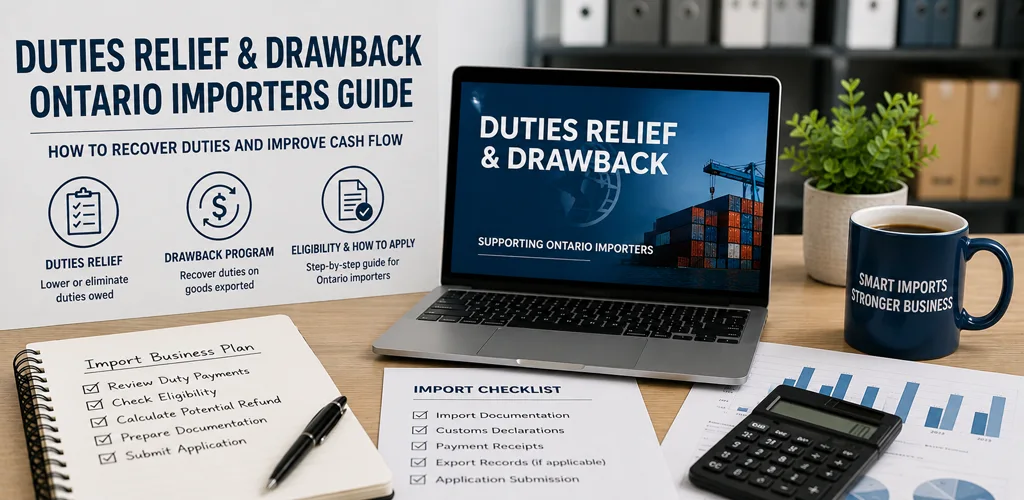
- The Duties Relief Program (DRP) lets qualifying businesses import goods without paying duties, as long as those goods are eventually exported.
- The Drawback Program works differently — you pay duties upfront, then apply for a refund once the goods are exported or destroyed.
- Both programs are administered federally by the Canada Border Services Agency (CBSA), not the province, and apply to Ontario importers/exporters like any other Canadian business.
- Applications and claims are submitted through the CBSA Assessment and Revenue Management (CARM) Client Portal.
- CUSMA places limits on how much duty can be recovered for goods later exported to the U.S. or Mexico, so not every claim recovers the full amount paid.
Two Different Tools, Two Different Timings
If your Ontario business imports materials or components and later exports the finished product, you may be leaving money on the table without realizing it. CBSA offers two related but distinct trade incentive programs:
- Duties Relief Program (DRP): Avoid paying duties upfront on goods you plan to export
- Drawback Program: Pay duties as normal, then claim a refund after export or destruction
The right one depends on your cash-flow situation and how predictable your export activity is.
How the Duties Relief Program Works
DRP lets approved businesses import commercial goods duty-free, provided they’re later exported — either in their original form or after being processed, assembled, or incorporated into another product.
Key details:
- You must generally export the goods within 4 years of importing them
- CBSA conducts periodic audits to confirm goods were actually exported as claimed
- If goods end up sold domestically instead of exported, duties become owing and must be voluntarily paid through an adjustment in CARM
How to apply:
- Complete Form K90, Duties Relief Application
- Submit it through the CARM Client Portal
- Maintain detailed records of import and export activity, since audits can happen at any time
How the Drawback Program Works
Unlike DRP, the Drawback Program is a refund mechanism — you pay duties at the time of import, then file a claim once the goods are exported or destroyed.
This program is more flexible than many importers assume:
- It applies to goods exported in original form or after transformation (assembly, packaging, manufacturing)
- Businesses that repackage or process imported goods can still qualify, as long as they can trace how the imported materials ended up in the exported product
- A related program, the Obsolete or Surplus Goods Program, covers goods that are destroyed or manufactured into obsolete/surplus items rather than exported
How to apply:
- Confirm the goods were both imported and later exported (or destroyed)
- Complete and submit Form K32, Drawback Claim
- Submit through the CARM Client Portal, along with proof of export
An Overlooked Use Case: Temporary Imports
If your business temporarily imports goods for testing, trade shows, or short-term use and then re-exports them, you may qualify for duty recovery under a separate tariff provision — without needing a full drawback claim. This can apply even when goods pass through Canada briefly before heading to another country.
The CUSMA Limitation to Know About
If your exports are headed to the United States or Mexico, CUSMA places restrictions on how much duty can be recovered through drawback or relief for certain non-CUSMA-originating goods. This mostly affects goods that weren’t originally made in a CUSMA country before being re-exported. It’s a detail worth confirming with a customs broker before assuming a claim will be fully recoverable, since the limitation applies to specific categories of goods rather than all imports uniformly.
Getting Set Up
Before filing anything, your business needs:
- A valid importer Business Number (BN15) account
- Registration on the CARM Client Portal
- Documentation linking specific import records to the corresponding export activity
Many businesses find it useful to set up a regular (monthly or quarterly) review of import and export records specifically to catch missed duty recovery opportunities before they age out of eligibility.
Where This Fits Into Your Broader Tariff Strategy
Duties relief and drawback claims won’t offset every cost tied to U.S. tariffs, but they can meaningfully improve cash flow for import-heavy Ontario businesses — freeing up working capital that might otherwise come from a loan program like POFP. For a full picture of what’s available, our complete guide to Ontario tariff relief breaks down how these federal customs programs fit alongside provincial loans and grants, and manufacturers in particular may also want to review our guide to tariff relief loans and tax credits.
* By using ontariolocalguide.ca, you acknowledge and accept the terms of our disclaimer.