
Key Takeaways
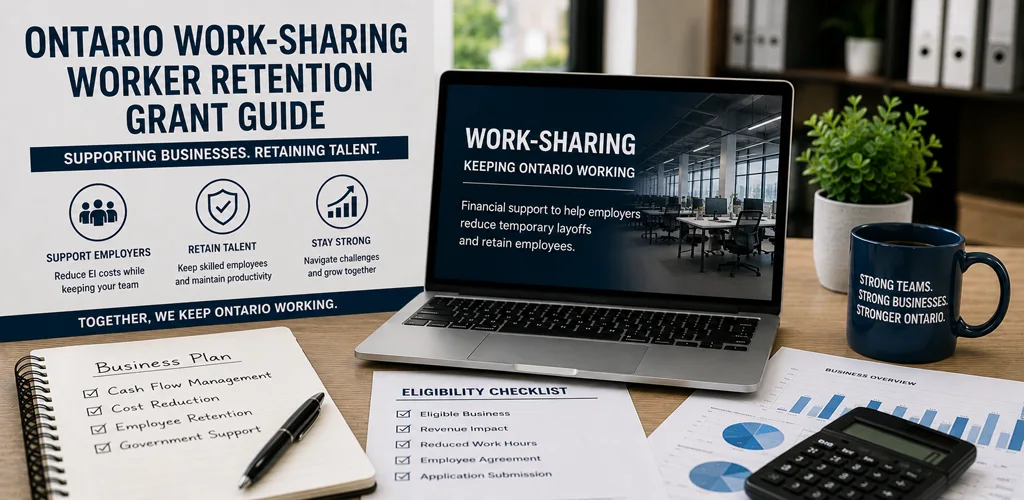
- The EI Work-Sharing Program lets employers reduce hours instead of laying off staff, with employees receiving EI benefits to offset the wage gap.
- Special tariff measures extend agreements to a maximum of 76 weeks (up from 38) and are now in effect until March 31, 2027.
- The new Worker Retention Grant tops up wages for employees on Work-Sharing who take training, boosting income replacement from about 55% to roughly 70%.
- Eligible employers need just 1 year in operation and 2 EI-eligible employees willing to reduce hours and share work — well below the program’s normal requirements.
- These are federal programs, so they apply to Ontario employers the same way they apply anywhere else in Canada.
Why This Matters for Ontario Employers
When tariffs squeeze revenue, the instinct is often to lay off staff. Work-Sharing offers a middle path: reduce everyone’s hours instead of cutting jobs outright, with government income support covering part of the gap. It’s especially relevant for Ontario’s steel, auto, and manufacturing employers, where layoffs would mean losing skilled workers that are expensive and slow to replace.
How the Work-Sharing Program Works
Under a Work-Sharing agreement, employees agree to a temporarily reduced work week, and the employer and employees share whatever work is available. Employees receive EI benefits to supplement their reduced income during this period.
Normally, agreements run 6 to 38 weeks. But under the special tariff measures currently in effect, the rules are considerably more flexible.
Special Tariff Measures — What’s Different Right Now
In response to U.S. tariffs, the federal government introduced temporary special measures, originally set to expire in March 2026 and now extended to March 31, 2027. These measures expand both employer and employee eligibility:
Expanded employer eligibility:
- Businesses operating in Canada for just 1 year (down from the usual 2-year requirement)
- Non-profits and charities experiencing revenue decline tied to tariffs
- Employers with a work activity decrease of less than 10% over the past 6 months, and use of Work-Sharing exceeding 60%
Expanded employee eligibility:
- Seasonal or cyclical employees, not just year-round permanent staff
- Employees supporting the employer’s recovery efforts
Other flexibilities:
- Maximum agreement duration extended to 76 weeks (from 38)
- Mandatory cooling-off period between agreements is waived
- Minimum agreement duration remains 6 weeks
Basic Eligibility to Apply
To qualify for Work-Sharing under the tariff special measures, an employer generally needs:
- To have been operating in Canada for at least 1 year
- At least 2 EI-eligible employees who agree to reduced hours and shared work
- A decline in business activity attributable to the threat or realization of U.S. tariffs
The Worker Retention Grant: Getting Paid to Train Instead of Lay Off
New as of February 2026, the Worker Retention Grant (WRG) builds directly on top of an existing Work-Sharing agreement. It tops up income for employees who are working reduced hours and participating in training, effectively raising income replacement from roughly 55% to about 70%.
Key details:
- You must already have an approved and implemented Work-Sharing agreement before applying — the Grant can’t be requested first
- Employers must commit to offering training for at least 40% of the weeks covered by the Grant agreement
- Training can be online or in-person, employer-led, facilitator-led, or peer-to-peer, and must happen during non-work hours
- The Grant does not cover the cost of developing or delivering the training itself — only the income top-up
- Application window: February 16, 2026 to December 31, 2026, at 3:00 p.m. EST
- Grant-supported projects must be completed by March 27, 2027, at the latest
How to Apply
- Apply for Work-Sharing first through Service Canada, confirming eligibility under the tariff special measures.
- Wait for your agreement to be approved and implemented — this is a prerequisite for the Grant.
- Apply for the Worker Retention Grant by email, including a training plan (500 words or less) describing how training supports skills development and worker retention.
- Use the Grant Calculator Workbook to estimate the supplement amount based on your employees’ EI benefit rate and hours reduction.
Employees aren’t required to participate in training to stay on Work-Sharing — but those who opt out won’t receive the WRG income supplement.
Where This Fits Into Your Broader Tariff Response
Work-Sharing and the Worker Retention Grant address a different problem than the loan and grant programs covered elsewhere in this series — they protect your workforce rather than your cash flow directly. For businesses managing both, it’s worth pairing this with financial support like the Protect Ontario Financing Program to cover payroll costs, or the BDC Pivot to Grow Program if a longer-term resilience plan is also needed. Our complete guide to Ontario tariff relief lays out how workforce and financial supports fit together.
* By using ontariolocalguide.ca, you acknowledge and accept the terms of our disclaimer.