Key Takeaways
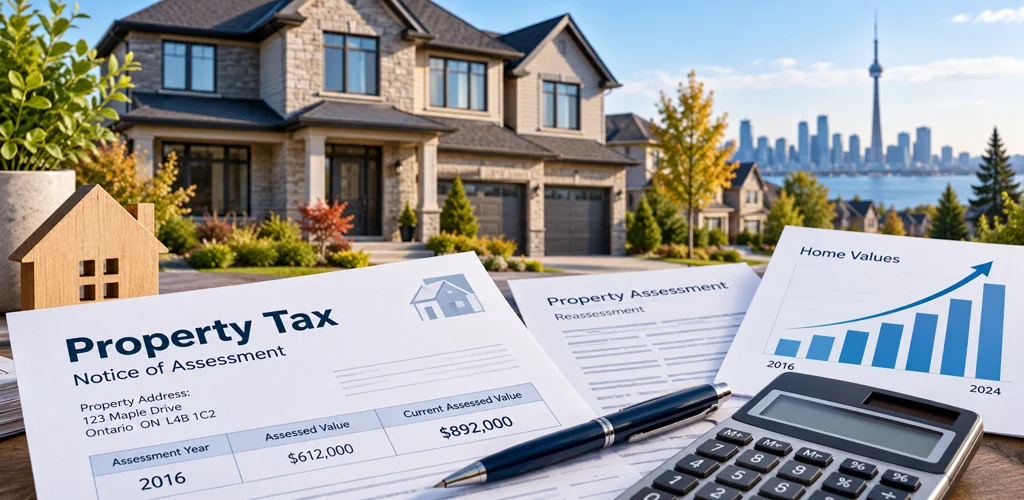
- Ontario property taxes are still calculated on what homes were worth on January 1, 2016.
- Average Ontario home prices have risen about 91% since that last assessment, according to National Post columnist Randall Denley.
- A reassessment doesn’t raise total municipal revenue, but it shifts who pays what. Some bills will rise and others will fall.
- Denley proposes replacing value-based taxes with a flat per-home charge. The idea has supporters and critics.
- Homeowners can review their assessment online now and file a free Request for Reconsideration by March 31 of the tax year.
A Decade-Old Snapshot of Your Home’s Value
Ontario used to reassess properties every four years and phase the new values in gradually. The update planned for 2020 was postponed because of the pandemic. In August 2023, the province extended that postponement through the 2021–2024 cycle, and later deferred reassessment again while it reviewed the system.
The result is that 2026 tax bills are still based on 2016 values, and no new valuation date has been announced. Even brand-new homes are assessed by estimating what they would have sold for in 2016.
Why It Matters During the Municipal Election
Ontario’s municipal elections take place on October 26, 2026, and property taxes are a key issue. Several mayoral candidates are promising restraint:
- Toronto: Olivia Chow pledges increases near inflation, while challenger Brad Bradford proposes a one-year freeze.
- Ottawa: Mark Sutcliffe promises two years of increases capped at 2.5%.
- Hamilton: Andrea Horwath vows to stay below inflation.
Denley argues these promises don’t address the bigger issue. Councils control the tax rate, but an eventual reassessment will reshuffle bills regardless of what any council approves.
How a Reassessment Would Change Your Bill
Reassessment is revenue neutral. A city collects the same total, but each property’s share is recalculated based on how its value changed compared to the local average. Homes that gained more than average pay a larger share. Homes that gained less pay a smaller one.
Here is a simplified example. Two homes in the same city were each worth $600,000 in 2016. Today, one might be worth $1.3 million and the other $900,000. They pay similar taxes now, but after a reassessment the first home’s owner would likely carry a noticeably bigger share.
The Price Tag of Running the System
The Municipal Property Assessment Corporation (MPAC) values roughly 5.6 million residential properties using around 200 factors. These include location, lot size, square footage, building age, construction quality, and features like pools, garages and fireplaces.
MPAC’s $262.5 million budget comes almost entirely from municipalities, which means it is funded by property taxpayers. Toronto contributes more than $51 million a year, and Ottawa about $15.2 million. MPAC has said publicly that it is ready to deliver a reassessment as soon as the province gives the go-ahead.
Denley’s Alternative: One Home, One Tax Bill
Denley suggests dividing each municipality’s residential tax requirement equally among all housing units. His reasoning is that every household has the same access to roads, police, fire services and transit, so home value is a poor measure of what each household uses.
He also points to “house-rich, cash-poor” owners, such as seniors who bought decades ago and now face high bills on fixed incomes. Phased in over several years, a flat system would end assessment-driven swings. After that, taxes would change only by the percentage councils approve.
The Counterarguments
Critics of a flat tax raise several concerns:
- Fairness: A small condo owner would pay the same as someone in a multimillion-dollar home.
- Big shifts for modest homes: Lower-value properties would see sharp increases during the transition.
- Existing relief tools: Seniors can already use municipal deferral programs and the Ontario Senior Homeowners’ Property Tax Grant, worth up to $500 a year.
- Legislation required: Any switch would need major provincial changes, which would take time.
For more on why bills have climbed in recent years, see our guide to Ontario property tax increases in 2026.
What Homeowners Can Do Now
You can’t control when the province acts, but you can prepare:
- Check your assessment. Log in to MPAC’s AboutMyProperty portal and confirm your lot size, square footage and features are correct.
- File a Request for Reconsideration if you find errors. It’s free, and the deadline is March 31 of the tax year.
- Plan renovations carefully. Additions and finished basements can increase your assessed value. Our guide on what to know before starting a renovation in Ontario covers permits and planning.
- Build a buffer. If your home has appreciated faster than your neighbours’, set money aside for a possible increase. Past reassessments were phased in over four years.
- Review your total housing costs. Property tax is only one of several rising expenses. Our article on why Ontario home insurance bills keep climbing covers another.
The Bottom Line
Ontario’s assessment freeze has kept bills predictable, but each year it continues, the eventual adjustment gets larger. Whether the province restarts reassessment or considers a different model like Denley’s, many homeowners will see their share of local taxes change.
Watch for provincial announcements after the October election, and keep your MPAC details accurate in the meantime.
Sources:
- Randall Denley: A costly property tax reckoning is due for Ontario homeowners (National Post via Yahoo)
- MPAC – The Assessment Cycle
- MPAC – Notices and Notifications
- Ryan Canada – What We Heard at AMO
- 2026 Ontario municipal elections (Wikipedia)
* By using ontariolocalguide.ca, you acknowledge and accept the terms of our disclaimer.