
Key Takeaways
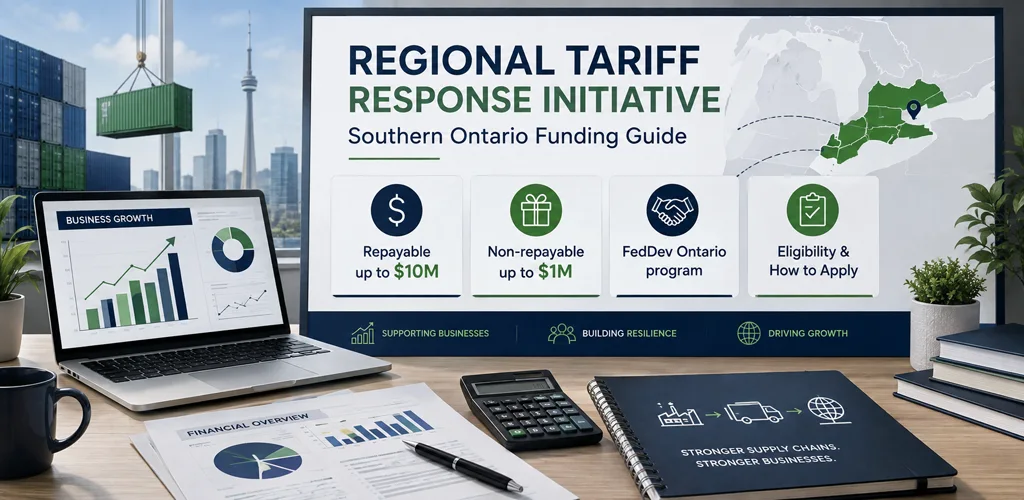
- The Regional Tariff Response Initiative (RTRI) offers repayable funding up to $10 million or non-repayable funding up to $1 million for southern Ontario businesses.
- This is a federal program delivered through FedDev Ontario — separate from provincial programs like POFP or the Ontario Together Trade Fund.
- Businesses must have at least 5 full-time employees in southern Ontario, fewer than 500 overall, and 3+ years of incorporation.
- Applicants choose either repayable or non-repayable funding, not both — and non-repayable funding can only be received once during the program’s lifetime.
- The initiative runs from March 2025 to March 2028, with retroactive eligibility for costs incurred back to March 21, 2025.
What RTRI Is Designed For
RTRI is one of several federal tools responding to U.S. and Chinese tariffs, delivered through the Federal Economic Development Agency for Southern Ontario (FedDev Ontario). It’s built to help businesses become more resilient — not just cover short-term losses.
Funded projects generally fall into two categories:
- Helping businesses boost productivity and cut costs to offset tariff impacts
- Strengthening domestic supply chains, diversifying markets, and future-proofing operations
Who Qualifies
To be eligible, a business (or Indigenous business) must:
- Be located and operating in southern Ontario
- Be incorporated and registered in Canada or Ontario for at least 3 years
- Operate as a for-profit business
- Employ at least 5 full-time equivalent staff in southern Ontario and fewer than 500 overall
- Have been viable prior to March 21, 2025 and before the tariffs took effect
On top of that, businesses must show either:
- At least 25% of sales in tariff-targeted markets, or
- Direct impact from trade disruptions — such as rising material costs, revenue decline, lost contracts, or workforce effects like layoffs or hiring freezes
Priority is given to businesses in the steel, automotive, and food security sectors, though all impacted sectors can apply.
Repayable vs. Non-Repayable Funding
This is the key decision point in an RTRI application — you must choose one:
| Repayable | Non-Repayable | |
|---|---|---|
| Funding range | $125,000 – $10 million | $125,000 – $1 million |
| Cost sharing | FedDev covers up to 75% | FedDev covers up to 50% |
| Your contribution | Minimum 25% | Minimum 50% |
| Limit | No lifetime cap noted | Once per business, ever |
Non-repayable funding also requires demonstrating a clear economic benefit to the local or regional economy — job creation, added value, or a meaningful role in the supply chain.
Costs and Timing
A few important details on how the money works:
- Eligible costs can be retroactive up to 12 months, but not before March 21, 2025
- Projects must be completed by March 31, 2028
- In-kind contributions don’t count toward your matching requirement — you’ll need real financing in place
- Total government assistance across federal, provincial, and municipal sources cannot exceed 90% of eligible costs (100% for Indigenous-led projects)
Combining RTRI With Other Programs
If you’re also applying to the Ontario Together Trade Fund or the Protect Ontario Financing Program as part of your matching funds, you’ll need to include evidence of that active application. One important rule: you can only submit one active application to FedDev Ontario at a time across all its programs, so RTRI can’t be paired with another FedDev program simultaneously.
How to Apply
- Complete the online self-screening tool to check preliminary eligibility.
- Decide between repayable and non-repayable funding based on your project size and how much matching capital you can provide.
- Gather documentation proving tariff impact — cost increases, revenue decline, or workforce effects.
- Submit your application with confirmed matching funding sources; approved projects must finalize a contribution agreement within 30 days.
Because funding is discretionary and subject to availability, an application doesn’t guarantee assistance — FedDev Ontario weighs factors like the minimum funding needed, other funding sources leveraged, and ability to repay. Given how many moving costs Ontario businesses are managing right now, from tariffs to rising hydro bills, it’s worth speaking with a tax or legal advisor before applying, since funding can carry tax and trade implications.
* By using ontariolocalguide.ca, you acknowledge and accept the terms of our disclaimer.