
Key Takeaways
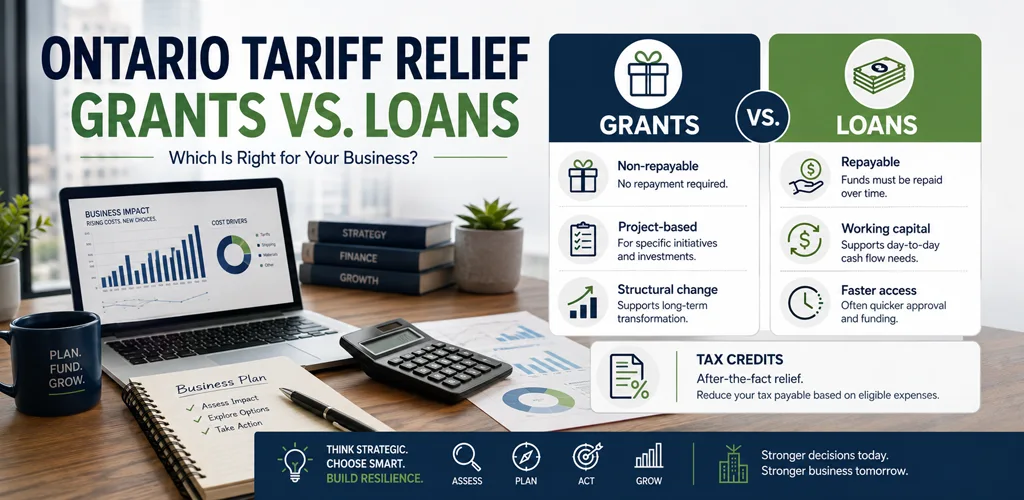
- Loans (repayable) suit businesses with a clear ability to repay who need capital now — for cash flow, equipment, or expansion.
- Grants and non-repayable contributions suit businesses making structural changes, like market diversification or reshoring, where the province wants to share the risk.
- Some programs, like the Ontario Together Trade Fund, blend both — offering a loan with a forgivable portion tied to performance.
- Tax credits are a third category entirely: they reduce cost after the fact rather than providing upfront funding.
- Most businesses end up combining more than one type, since loans and grants typically solve different problems.
Why This Question Matters
With so many programs available, Ontario business owners often get stuck comparing dollar amounts rather than asking the more useful question: what kind of support actually fits my situation? A $40 million loan and a $1 million grant solve very different problems — the loan assumes you can pay it back with future revenue, while the grant assumes the province wants to share in the cost of your project without expecting repayment.
Loans: Best When You Need Cash Now
Loan-based programs are generally faster to access and cover a wider range of uses, but they come with repayment obligations and typically require demonstrating financial stability.
Choose a loan if:
- You need to cover immediate working capital — payroll, rent, utilities
- Your business has positive cash flow and can realistically service debt
- You want funding without giving up equity or committing to strict performance targets
Ontario’s main loan-based options:
| Program | Best for | Range |
|---|---|---|
| Protect Ontario Financing Program | Working capital for tariff-hit sectors | $250K–$40M |
| BDC Pivot to Grow | Liquidity or longer-term pivot financing | Up to $5M |
| Regional Tariff Response Initiative (repayable stream) | Southern Ontario project financing | $125K–$10M |
Grants and Non-Repayable Funding: Best for Structural Change
Non-repayable funding is harder to qualify for and usually requires matching investment from your business, but it doesn’t need to be paid back — which matters if your project carries real execution risk.
Choose a grant or non-repayable contribution if:
- You’re investing in long-term adaptation — reshoring, new markets, technology
- You can fund a meaningful share yourself (matching requirements often run 25–50%+)
- Your project delivers measurable public benefit, like job creation or supply chain resilience
Ontario’s main non-repayable options:
| Program | Best for | Range |
|---|---|---|
| Ontario Together Trade Fund | Market diversification, reshoring | Up to $5M (10–75% of costs) |
| Regional Tariff Response Initiative (non-repayable stream) | Regional economic benefit projects | $125K–$1M |
Tax Credits: A Different Kind of Relief Entirely
Tax credits like the Ontario Made Manufacturing Investment Tax Credit don’t hand you money upfront — they reduce what you owe (or get refunded) after you’ve already made a qualifying investment. They’re most useful alongside a loan or grant, not instead of one, since they reward capital spending you’ve already committed to rather than funding it in advance.
Similarly, duties relief and drawback programs recover costs you’ve already paid or help you avoid paying them — another form of relief that works alongside, not in place of, direct financing.
A Quick Decision Framework
Ask yourself these questions in order:
- Do I need money in the next few weeks to cover payroll or rent? → Look at loans first, starting with POFP or Pivot to Grow.
- Am I planning a project (new equipment, new markets, supply chain changes) over the next 1–2 years? → Look at grants and blended programs like OTTF or RTRI’s non-repayable stream.
- Have I already made or am I about to make a capital investment? → Check whether OMMITC or duty recovery programs apply.
- Is my main issue keeping staff employed through a slowdown? → That’s a workforce program, not a financing one — see our guide to Work-Sharing and the Worker Retention Grant.
Why Many Businesses Use Both
In practice, a manufacturer facing tariff pressure might combine a POFP loan to stabilize payroll now, an OTTF grant to fund a market diversification project over the next year, and OMMITC to offset the tax cost of new equipment purchased along the way. These programs are generally designed to be stackable, though each has its own rules about combining with other provincial or federal funding — something worth confirming before finalizing an application strategy.
Before You Apply
Program terms across this space have shifted more than once in the past year — eligibility thresholds, funding caps, and even intake periods can change with little notice as tariff measures themselves evolve. It’s worth checking current details directly with each program before applying, and revisiting our complete guide to Ontario tariff relief periodically, since that hub page tracks the full picture across every program in this series.
* By using ontariolocalguide.ca, you acknowledge and accept the terms of our disclaimer.